A central question in computational neuroscience is how the brain solves the credit assignment problem. How do individual synapses determine how to adjust their strengths based only on locally available information to improve a global objective? In a recent preprint, Safaai, Richards, and Sabatini (2026) demonstrate that exact gradients in conductance-based dendritic networks can be mathematically factorised into a local eligibility term and a non-local compartment error term. That factorisation reframes local learning as a credit-signal approximation problem, and it puts the biophysics inside the gradient rather than alongside it — dendritic geometry and synaptic conductance turn out to be terms in the credit calculation, not context around it. The paper then tests a natural follow-on hypothesis (that shunting inhibition reshapes the error field to suit the feedback a neuron can actually receive) and does not find general support for it. Both halves of that are worth the read.
The core challenge: local constraints and global objectives
The biological credit assignment problem is constrained by physical reality. A synapse only has access to locally available information like the presynaptic firing rate, the local membrane voltage, and the local driving forces of specific ion channels. The synapse must update its weight to reduce errors in a global network output, like a mistaken classification or a poorly executed motor movement.
In standard artificial neural networks, backpropagation solves this cleanly by computing exact gradients. Backpropagation requires passing a global error signal backward through the entire computational graph. This involves synchronised forward and backward passes, the transmission of signed error values, and perfectly symmetric forward and backward synaptic weights. These features are biologically implausible.
Think of backpropagation like a meticulously maintained ledger in a corporate headquarters where every fraction of a cent is tracked and reconciled perfectly across every department globally. Biological credit assignment is more like franchise managers trying to optimise their local store’s profit based only on foot traffic and a single daily stock price update from head office. The local managers must compress that single global signal into meaningful local action.
Moving beyond point neurons
The authors move beyond the simplified point neuron models typically used in deep learning, where inputs are linearly summed and passed through a static nonlinearity. Real biological neurons possess extensive dendritic trees that non-linearly integrate thousands of synaptic inputs.
Biological synapses operate as conductances instead of simple additive weights. They open specific ion channels, allowing current to flow depending on the local driving force ($V_m - E_{rev}$). The authors focus heavily on shunting inhibition.
Inhibition is usually sorted into two kinds, divisive (shunting) and subtractive (hyperpolarising), and the sorting is looser than it looks. A synapse is purely shunting when its reversal potential ($E_{GABA}$) is exactly equal to the resting membrane potential. In this state, activating the synapse does not change the voltage at rest, but it increases the local membrane conductance. This effectively short-circuits the membrane. It non-linearly reduces the impact of subsequent excitatory currents by letting them leak out.
When an inhibitory synapse is hyperpolarising ($E_{GABA} < V_{rest}$), it performs both operations. It subtracts voltage by driving the membrane potential downwards, and it acts divisively by increasing the membrane conductance exactly as a shunting synapse does. Comparing shunting to hyperpolarising inhibition is not a perfectly orthogonal comparison of divisive versus subtractive effects. Focusing specifically on the conductance (shunting) effect isolates how changes in input resistance shape signal integration.
Imagine a water pipe representing a dendrite. Excitatory input is water flowing in. Hyperpolarising inhibition is a pump pulling water out of the pipe (subtraction) while also springing a leak in the side of the pipe (division). Shunting inhibition is just opening a leak in the side of the pipe. When the pipe is empty (at resting potential), the leak does nothing. But when water flows in, the leak severely reduces how much water makes it to the end.
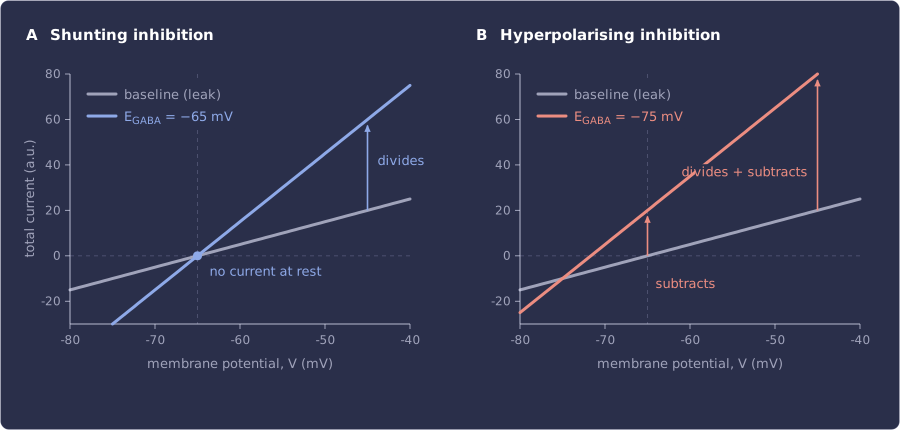
One caveat before reading this across to the paper: the contrast drawn here is shunting against hyperpolarising inhibition, whereas Safaai et al.’s control is shunting against a purely additive core with no conductance denominator at all. Both conditions above triple the slope, and that shared conductance increase is the divisive term. Shunting has nothing else. Only hyperpolarising inhibition additionally lifts the intercept, and that offset is the subtractive part. Which is exactly why the two are not an orthogonal comparison of division against subtraction: one contains the other.
This focus on the spatial geometry of conductance builds on a long foundation of dendritic research. Gidon and Segev (2012) showed that inhibition has a profoundly asymmetric spatial effect in dendritic trees: placing inhibitory synapses “off-path” (farther from the soma than the excitatory input) dampens proximal excitable hotspots more effectively than placing them on-path, and the effect spreads centripetally well beyond the synapses themselves.
This connects to my own work on chloride dynamics and dendritic excitability, where we found that the inhibitory effectiveness of separate dendritic branches combines where they meet, so the most inhibitory arrangement is one that closely encircles a branch junction without sitting on it. Two distinct optima live in that result and it is worth keeping them apart. Under static chloride the inhibitory effect itself is strongest right at the junction, though the ratio measuring how much separate branches combine peaks a little way off it under shunting, around 0.2 electrotonic lengths. Once chloride dynamics are included, the placement that maximises inhibition outright settles at roughly 0.07 electrotonic lengths — close to the junction but not on it, trading a little strength for a lot less chloride loading. The accumulation itself is largely independent of $E_{GABA}$, so it holds for shunting and hyperpolarising alike — but hyperpolarising inhibition keeps accumulating at the junction even from very distal synapses, whereas under shunting there is an optimal distance beyond which the effect falls away. Safaai et al.’s conductance model is a shunting one, where placement is the less forgiving of the two. Their contribution is to take these dendro-centric principles and ask what they do to learning, rather than to instantaneous excitability.
Factorising the exact gradient
The central theoretical contribution of the Safaai et al. paper is demonstrating that exact gradients in these biophysical models can be mathematically factorised into two distinct terms:
\[\Delta w_{ij} \propto \text{Local Eligibility} \times \text{Compartment Error}\]- Local Eligibility: This term depends entirely on variables directly accessible at the synapse, including presynaptic activity, the local driving force, and the local input resistance.
- Compartment Error: This is a fast, non-local term representing a path-specific error signal. It is what you get by carrying an error from the soma back out along the tree, scaled at each step by the gains of the branches it passes through.
This factorisation reframes local learning. The synapse computes its update by multiplying its perfect local eligibility by whatever approximation of the compartment error it receives. The core challenge becomes a credit-signal approximation problem — or as the paper sharpens it later, a feedback-compatibility one, since low intrinsic rank buys you nothing unless the error field actually lines up with the feedback you have. How well can the complex, high-dimensional true error field be approximated by the restricted feedback signals available to a biological neuron — and, the sharper question, does what survives actually line up with the error the synapse needs?
The reshaping role of shunting inhibition — and the null
Here is the hypothesis, and it is a good one. Under biological constraints, somatic feedback might be limited to a global scalar or some low-rank structure. Shunting inhibition locally modulates input resistance and dendritic gain across the tree, so it could reshape the compartment-error field — dynamically tuning the dendrite’s electrical properties until the error approximation a synapse can actually receive lines up better with the one it needs. The paper states this as a question rather than a claim: “We test whether shunting improves learning when its effect on dendritic gain makes compartment errors more compatible with restricted feedback.”
The answer is no — or more precisely, not generally. In the main comparison the shunting model is run against a plainer additive one: same tree, same five-factor protocol, but without the driving-force and input-resistance terms that make a conductance a conductance. Each core’s rule comes from its own forward dynamics, which is the right way round — the alternative would be handing an additive model a rule derived from shunting. Shunting does come out modestly ahead of it under the paper’s main feedback condition, which is presumably why the hypothesis looked live.
The diagnostics are extensive: “Exact-gradient reconstruction verifies the factorization, while path-gain, feedback-fidelity, inhibition-intervention, and transported-error controls probe the mechanism and its limits.” They do locate the real bottleneck. But on the shunting hypothesis itself the abstract is blunt: “shunting has no general advantage under matched initialization.” The phrase doing the work is matched initialisation. Give both architectures the same starting conditions and the advantage disappears.
Worth knowing that the paper changed its mind about this. The first version of the preprint, posted a few weeks earlier, reported that its diagnostics “support the proposed mechanism”; the revision replaced that with the matched-initialisation null and reframed the whole problem as one of feedback compatibility rather than signal compression. Not merely a harder reading of the same evidence, either — the headline feedback condition itself changed between versions, from a per-soma signal to matched-width feedback with a scalar fallback. Revising a claim downward on your own initiative is rarer than it should be, so it seems worth saying out loud rather than quietly citing v2 and moving on.
This is the part I would least want to see summarised away, because it is the part most likely to be. A well-motivated mechanistic hypothesis, formalised properly, given a fair test, and it did not survive. That is a good paper doing its job. The factorisation theorem stands regardless, and it is the durable contribution here — the shunting story was the hook, not the result.
Empirical benchmarks and bottlenecks
The authors implemented a local credit assignment algorithm (LocalCA) using these principles and tested it on MNIST, Fashion-MNIST, and a figure-ground version of MNIST. Constrained, in the paper’s terms, to “nonnegative conductances and a five-factor rule using matched-width feedback with scalar fallback”, shunting LocalCA learned — and then stopped short, remaining “5 to 6 percentage points below matched backpropagation” on all three.
That gap is the crucial finding, and the controls say where it comes from. Loosen the feedback and it largely closes: “A three-factor rule approaches matched backpropagation with exact transported feedback in the shunting model and with neuron-wise feedback in both architectures.” So the limit is not the eligibility term, which is exact, and not the dendrites. It is the feedback: compressed error signals cannot carry the precise, high-dimensional gradient that unconstrained backpropagation computes, and the reshaping shunting provides does not change which part survives the compression. The paper’s own summary puts it plainly — “feedback fidelity remains a major bottleneck”.
Implications for neuroscience and artificial intelligence
For neuroscience, the durable contribution is the factorisation itself. Their own closing line is the one to keep: the results “show how conductance and dendritic branching enter the exact credit equation and identify restricted feedback as a principal limit.” The PDF’s version of that sentence ends “in these experiments”, and the arXiv listing page drops the qualifier; take the narrower reading. That much holds whether or not the shunting hypothesis does. It is tempting to go further and cast dendrites as necessary participants in solving credit assignment, an optimal router for error signals, but the paper does not establish that and does not claim it. Its own conclusion points elsewhere: restricted feedback is a principal limit.
For NeuroAI, the result highlights how hard it is to mimic backpropagation with biologically plausible mechanisms. It is tempting to read that persistent 5 to 6 percentage point gap as evidence that brains are not running a noisy version of backpropagation at all, and I would like that to be true. But I have just attributed the gap to a restriction the modellers imposed, not to anything biology chose, so the honest version is narrower: under this feedback constraint, a local rule does not reach backpropagation. Brains might be running something else entirely, or exploiting physical constraints that a benchmark optimising for classification accuracy has no way to reward.
Limitations and open questions
The headline results sit on MNIST and its variants, with CIFAR-10, cue-routing and direct-feedback-alignment controls alongside them. Whether the mechanism holds up where the required error signals are deeper and more structured is the obvious next question, and the paper does not pretend to have answered it.
The larger caveat is that the feedback restriction is a modelling choice rather than a measurement. What the paper establishes is that this compression of the error signal costs 5 to 6 percentage points; what the cortex actually sends back down is still contested, and a different restriction would produce a different number. Whether biological systems get around the bottleneck at all, through pathways we have not found or by optimising something that is not a precise gradient, is genuinely open. To the authors’ credit they name candidate carriers (apical, burst, plateau, neuromodulatory) without claiming any of them is the answer.
What I keep turning over is chloride. In our own modelling work, sustained inhibitory input loads the cell with chloride and degrades the inhibitory driving force over time, and the Safaai et al. model is static in exactly that respect. It is tempting to conclude that chloride loading would therefore compromise the error-field reshaping. Mostly it does not, and for an interesting reason: the conductance stage of the path gain is built from conductances alone, with no reversal-potential term in it. Chloride shifts $E_{GABA}$, not $g_{GABA}$, so the lever the shunting hypothesis actually pulls goes untouched. There is an indirect route — $E_{GABA}$ moves the local voltage, which moves the activation derivative that the full effective gain carries — but it is second-hand. What chloride degrades directly is the driving-force factor sitting inside the local eligibility, and the forward voltages that factor is computed from. Which is arguably the more interesting failure mode: the error signal keeps its shape while each synapse’s estimate of how far it should move drifts out from under it.
If a synapse’s local eligibility is tied to its instantaneous reversal potential, then the neuron’s recent history sets how much it can learn right now — and the placement that minimises dendritic excitability may also be the placement that keeps credit assignment stable over hours rather than seconds. That is the same balance we struck for excitability, arrived at from the other direction: close enough to the junction to stay strong, far enough out that chloride can diffuse away in several directions instead of pooling.
Which suggests the experiment I would most want next, and it is a simulation rather than a rig: run the same factorisation with chloride free to move, and see whether the eligibility term drifts far enough, over a realistic training run, to matter.
References and resources
- Safaai, H., Richards, M., & Sabatini, B. L. (2026). “Shunting Inhibition and Dendritic Branching Shape Local Credit Assignment.” arXiv preprint arXiv:2607.03556v2. https://arxiv.org/abs/2607.03556v2 Quotations above are from the v2 abstract as it appears on the arXiv listing page, whose wording differs slightly from the PDF’s.
- Gidon, A., & Segev, I. (2012). “Principles governing the operation of synaptic inhibition in dendrites.” Neuron, 75(2), 330-341. https://doi.org/10.1016/j.neuron.2012.05.015
- Currin, C. B., & Raimondo, J. V. (2022). “Computational models reveal how chloride dynamics determine the optimal distribution of inhibitory synapses to minimise dendritic excitability.” PLOS Computational Biology, 18(9), e1010534. https://doi.org/10.1371/journal.pcbi.1010534