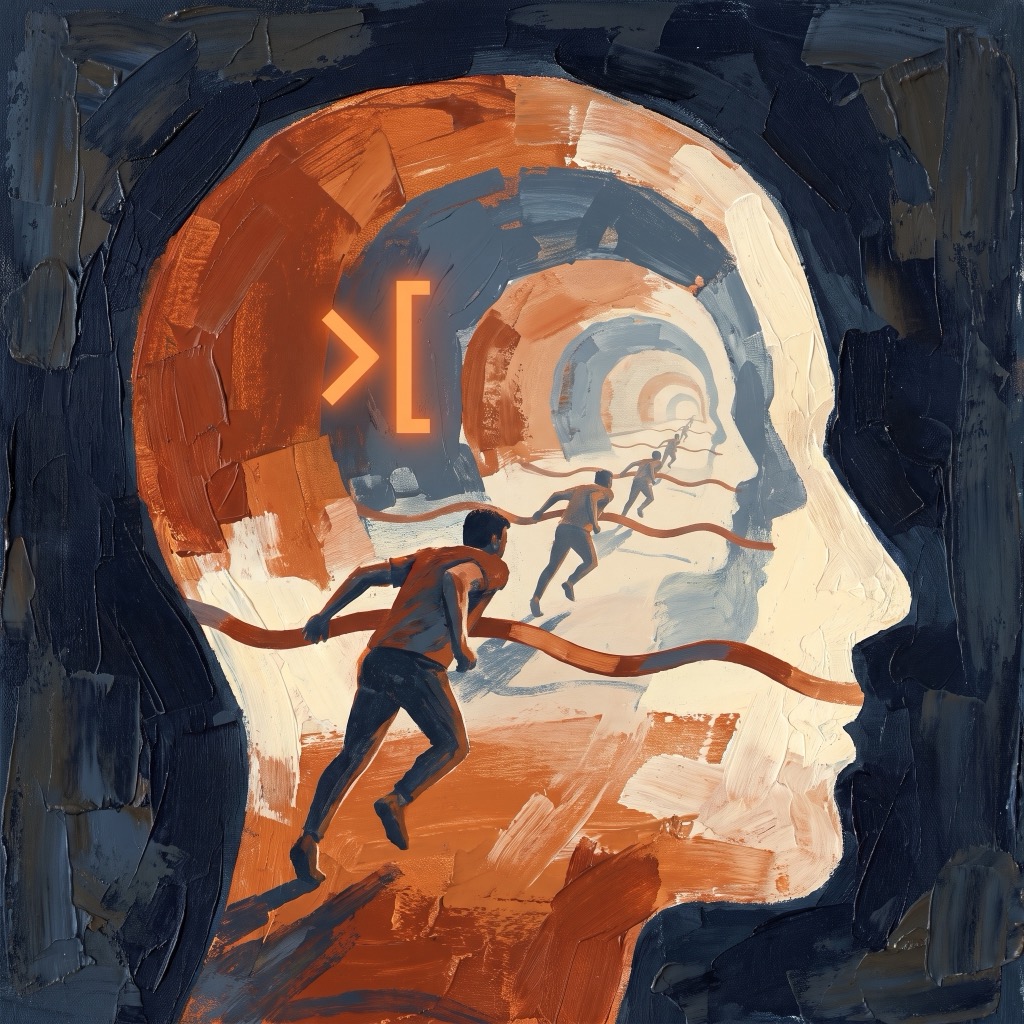
Just one more prompt.
I have said it to myself, and less forgivably out loud to my wife, more times this year than I would like to count. One more prompt and the draft is done. One more and the bug is gone. One more and the figure is finally, actually right. I am never intentionally lying when I say it. I am just, reliably, wrong.
For most of the history of making things, the expensive part was the doing. Writing the paragraph, drawing the diagram, refactoring the function: each iteration cost real time and real effort, and that cost did quiet, useful work. It made you stop. You shipped the good-enough version because the great version was not worth another three hours. The friction was a feature.
AI agents have removed the friction. Now the next iteration costs a sentence and a few seconds of waiting, and automated workflows and agent loops push it further still, running step after step while you try to keep up. The barrier to making the next version of almost anything has fallen dramatically. That is mostly a good thing, though on critical or genuinely complex work, waving through every change an unattended loop proposes is how you drift somewhere you didn’t intend.
Yet, you can do more! The ideas that seemed out-of-reach because they would take too long to implement, the prototypes that require a lot of upfront effort, and the pieces of writing that just got stuck in the inertia phase, are all now that much more accessible. For those with curious minds, having multiple agents working on multiple problems simultaneously is a great way to explore, learn, and build. The catch, which we’ll come to, is that the agents can run in parallel; your attention can’t.
But there can be consequences to this: burnout. Not the dramatic kind, the quiet kind, the sort that creeps up on work you actually enjoy. Agents made iteration nearly free, and unchecked, a frictionless loop is a surprisingly efficient way to burn yourself out. The mechanism in the middle is context-switching; the way back out is learning, again, to stop on purpose. It is, of course, more complicated than that™.
The finish line keeps moving
Here is the first trap, and it is an old one. We are terrible judges of how close we are to done.
Software people have a name for it. The ninety–ninety rule: the first 90% of the code takes the first 90% of the time, and the remaining 10% takes the other 90% [1]. It is a joke that sums to 180%, and it has been roughly true since Bell Labs in the 1980s, long before anyone prompted anything. Psychologists have a broader name, the planning fallacy [2]. We systematically underestimate how long our own tasks will take, even when we can clearly remember the last one running long. The estimate feels credible every single time. That is what makes it a fallacy rather than a one-off mistake.
There is a mechanical pull, too. Hull watched rats run faster the closer they got to the food, the goal-gradient effect [3]. Decades later, Kivetz and colleagues found people do the same. Coffee-card customers buy faster as the free cup nears, and, tellingly, a card pre-stamped with two “bonus” stamps gets completed faster than an identical shorter one. The perception of being nearly there accelerates the effort, whether or not you are actually nearly there.
Now put that ancient machinery in front of a tool that will genuinely generate the next version of almost anything. The last 10% still doesn’t end, but now you can attack it indefinitely, five percent at a time, forever. The finish line was always a little illusory. Agents make it infinitely movable. Each prompt sets a fresh little finish line right in front of you, so the goal-gradient keeps re-arming even as the real end recedes. You can always improve it, so you always might.
Not a dopamine hit, a wanting machine
It is tempting to wave at all this, say “dopamine”, and feel explained. Dopamine is a useful hook. It is also, on its own, wrong, or at least far too small.
Dopamine is not the pleasure chemical. Schultz’s recordings showed that dopamine neurons don’t fire for reward; they fire for surprise about reward, the gap between what you expected and what you got [4]. Expected reward: nothing. Unexpected reward: a burst. Expected reward that fails to arrive: a dip below baseline. It is a prediction-error signal. (The reflexive irony, for anyone building these systems: that same error signal is the ancestor of the temporal-difference learning inside the reinforcement-learning agents we now can’t stop prompting. The brain and the bot are running versions of the same loop.)
The sharper distinction comes from Berridge and Robinson, who spent decades prising apart two things we usually blur: wanting and liking [5]. Dopamine drives wanting, the pull towards, and it is dissociable from liking, the actual pleasure of getting. You can want intensely something you no longer enjoy. This is the most honest description I know of the 11pm prompt. I am not enjoying this. I am not even sure the output is better. I want to run it anyway. Wanting and liking have come apart, and the tool is happy to feed the wanting all night. It is what Panksepp called the SEEKING system, the appetitive engine that motivates the pursuit rather than the catch [6].
Give that drive an infinite search space and a near-zero cost per search, and it does not settle. The schedule matters, too. Skinner showed that variable rewards, unpredictable payoff per attempt, produce the most persistent behaviour of all [7]. It is the slot-machine schedule. “Will this prompt be the one?” is a lever, and I keep pulling it.
The cruellest detail is the near-miss. When gamblers almost win, they rate it as less pleasant, and it increases their urge to keep playing, lighting up the same win circuitry as an actual win [8]. The effect is strongest when they feel they had control over the outcome. A nearly-working output is a near-win. Prompting is the near-miss with the control dial turned all the way up: it is my next instruction that will surely fix it. That feeling is doing exactly what it did in the casino. The difference is that here it is sometimes right, the next instruction really can fix it, which is exactly what makes it so hard to overrule.
None of this is a moral failing, and none of it is “just dopamine”. It is wanting decoupled from liking, seeking without a stop, an intermittent schedule, and a near-miss you feel personally responsible for closing. That is a lot of well-tuned biology to out-argue at midnight with willpower alone.
The cost is the switching, not the work
So far this sounds like a productivity quirk. The reason it is more than that is the switching. The machine holds a dozen loops at once without strain; you do not.
Every time you break off one thing to chase another (one more prompt, one more tab, one more “quick” fix) you don’t arrive at the new task cleanly. Leroy called what’s left behind attention residue: part of your mind stays stuck on the thing you just left, and you perform measurably worse on what’s now in front of you [9]. Her crucial finding, for us, is that the residue is worse when the previous task was left unfinished. Which is precisely the state a half-finished iteration leaves you in, over and over, all day.
Gloria Mark has been timing this for twenty years. Average attention on a single screen before switching fell from about 2.5 minutes in 2004 to roughly 47 seconds in recent studies [10]. (You will see “23 minutes to refocus” quoted everywhere; it traces to an interview, not a paper, so I’ll keep the honest shape and leave the false precision out. Switching back is slow and costly.) And when work is interrupted, people don’t necessarily slow down. Mark’s team found they often go faster to compensate, and pay for it in stress, frustration, and time pressure [11]. The cost isn’t always in the output. It is in the body.
The AI-specific twist is the part that unsettles me. In a small, careful trial, experienced developers using AI tools were 19% slower on real tasks, while believing they were about 20% faster [12]. The sample was tiny and the setting hard, so don’t conclude anything too quickly. But the direction is the point: the felt speed and the real speed came apart, the same way wanting and liking did. The loop feels productive from the inside even when it isn’t. That is exactly what feeds “just one more”. And there is an unlovely word for what a fast, frictionless loop tends to spit out: slop [13]. We used to talk about getting shit done; the newer failure mode is getting slop done, which manages to be both busier and emptier.
Burnout on things you enjoy
Stack all of that up, the residue and the interruption stress and the low hum of the thing you didn’t quite finish, and you have the raw material for something worse than a bad day. Chronic activation of the stress response has a name and a cost: McEwen’s allostatic load, the cumulative wear of a system that never gets to stand down [14]. The stress response is superb for a sprint from a lion and corrosive as a way of life [15].
Burnout, in the actual science, isn’t simply “too much work”. The WHO now recognises it as an occupational phenomenon, with three faces: exhaustion, cynicism, and a shrinking sense of efficacy [16]. Maslach’s work locates its causes in a set of mismatches, and the two that the one-more-prompt loop attacks hardest are workload and control. Not “the work is heavy” so much as “I never get to decide when it’s done”. The finish line moved, so you never get the small, real relief of having crossed it.
Which brings me back to a line I once wrote for myself and then, apparently, ignored: burnout can happen on things you enjoy. Especially those, I now think. The tools didn’t make the work worse. They made it endless, which is a different and sneakier problem. And I don’t only see this in myself. I see it in collaborators and students, heads-down past midnight on something they genuinely love, which is part of why I wanted to write it down.
A caveat about the seams. The direct claim, that AI iteration loops cause burnout, has not, as far as I can find, been studied head-on. I have joined up well-established parts: the biology of wanting, the cost of switching, the science of burnout. That makes it a reasonable hypothesis, not a proven one. More complicated than that, again.
Deciding what “done” means
Deliberation, it turns out, cuts both ways.
The trouble is undirected deliberation: the endless, low-friction iterating, each pass feeling like a decision when it is really just a lever-pull. Over-deliberation crowding out the moment you should have shipped. (This is, for the record, my own oldest bad habit, agents or no agents.)
There is a version of this I have pressed on every PhD student I have mentored, long before agents existed. You cannot know everything; you cannot even finish everything. Time makes prioritising compulsory, and prioritising means choosing what to leave undone. The last five percent of one thing is always, quietly, the decision not to start the next thing, or not to turn to the person or the project waiting elsewhere. Stopping is not the enemy of good work. It is how you stay free to do the next good work.
The answer, then, is deliberate deliberation: deciding, in advance and on purpose, what done means. Oddly, this asks less of your willpower, not more. Willpower is exactly what a well-tuned wanting will beat at midnight, so don’t build your defence on grit; build it on structure.
A few things with actual evidence behind them:
- Pre-commit the stopping rule. Gollwitzer’s implementation intentions, simple “if X, then Y” plans, reliably beat vague good intentions [17]. If the tests pass, I commit and stop. If it’s 6pm, I stop. If I’ve done three iterations, I sleep on it. Decide the threshold before you are inside the wanting. The rule works precisely because it fires on a cue instead of a struggle: you are not deciding at midnight, you already decided.
- Batch the switching. Fewer switches, less residue. Checking email a few fixed times a day measurably lowers stress compared with checking constantly [18], and the same logic applies to compulsively re-prompting. Give the loop windows, not the whole day.
- Recover on purpose. The most protective thing after work isn’t rest exactly, it is psychological detachment, actually switching the problem off rather than ruminating on the unfinished bit [19]. And what restores worn-out attention is soft fascination, a walk, some greenery, something that lets the mind idle, not another screen [20]. Doomscrolling is not recovery.
Sometimes the fix is not to push the loop but to leave it, on purpose, and start again from a blank page. This turns out to be true for both halves of the human-and-machine pair. Large language models degrade as their context window fills: they use the beginning and end of a long input far better than the middle [21], and grow less reliable the more you pack in, a decay now informally called “context rot” [22]. We are not so different. John Cleese tells a story about a sketch he wrote for Monty Python, which he then lost and had to rewrite from memory. The second version came out noticeably better, tighter and funnier, though he had only been trying to remember it, not improve it [23]. His explanation is that the mind keeps working after you consciously put a problem down, so a first attempt is rarely worth the grip we keep on it.
So when an agentic loop is spinning and the context, yours or the model’s, is thick with false starts, the move is sometimes not one more prompt but a fresh one: clear the window and begin again, this time with a sharper idea of what “done” looks like. Starting over is not the work lost. It is the same idea with the clutter gone.
Notice that none of these ask you to want it less. They just put the decision somewhere the wanting can’t reach: in advance, in a rule, on a walk, on a clean page.
The fear of missing out
Stopping has an enemy that points outward, too. Not wanting more of the thing in front of you, but fearing everything that is not: the fear of missing out (FOMO).
With agents it arrives in two flavours. There is the road not taken, the sense that while you work on this, an agent could be working on that, and that, and three other thats, so that every idea you have not spun up registers faintly as a loss. And there is a stranger, more modern version: the agent is working, right now, and you feel you ought to be watching, that its next step might be the one you need to see, that to look away is to fall behind your own tools.
Neither feeling is imagined. Psychologists named and measured the general case over a decade ago, and found it associated, at least, with lower mood and lower life satisfaction, though which way the arrow runs is not settled [24]. The version aimed squarely at these tools is new enough to have earned its own unlovely heading, “AI FOMO”, and its own first studies [25]. The watching has a name of its own: telepressure, the urge to stay responsive and keep checking, which tracks with worse sleep and more burnout [26]. An always-on agent is a telepressure machine with a bottomless backlog, and every glance back at it is another switch, carrying all the residue we have already met.
Underneath sits something older and faintly absurd. We are averse to idleness. Given even a flimsy reason to stay busy, people take it, and report feeling better for the busyness, even when it leads nowhere [27]. We do not merely tolerate work; we reach for it, and are grateful for an excuse. The agent is a bottomless supplier of excuses.
But a fixation on productivity does not pay forever. Even for plain output, more is not simply more. In one careful study of working hours, output climbed with effort up to a point and then flattened, so that someone working seventy hours produced barely more than someone working fifty-six [28]. That was manual work a century ago, so hold the number loosely, but the curve is familiar to anyone who has pushed past their own good sense at midnight. And the people who guard their time rather than squeeze it for more tend, on the whole, to be a little happier for it [29]. The returns on doing more level off, and then they tip downward.
Which is where prioritising comes back, and where it stops being a tactic and becomes a small grief. To be intentional with your time is not only to choose what to do. It is to accept, on purpose, what you will miss: the other loop, the other idea, the progress you did not stand and watch. We cannot do everything. We have to choose. That can genuinely sting. But missing out is not a fault in the system; it is the shape of a finite person actually choosing, which is the only way anything gets chosen at all.
One more prompt
I don’t want to end where this genre usually ends, wagging a finger at the tools. The tools are extraordinary. The collapse of friction is, most of the time, a gift: it lets a curious person try ten things where they used to manage one. The point was never to iterate less because iterating is bad. It is to choose when to stop, so that the making stays something you like and not just something you want.
The machine will always be available for one more prompt. But as humans, we each need to know for ourselves - deliberately, in advance, and out loud if it helps - when to say: this is done. Not perfect, but good enough. Done.
I’m still figuring it out. I’ve rewritten this post multiple times. But I’m going to stop now, on purpose.
Notes and sources
[1] The “ninety–ninety rule” is attributed to Tom Cargill of Bell Labs and popularised by Jon Bentley in his “Programming Pearls” column (“Bumper-Sticker Computer Science,” Communications of the ACM 28(9), September 1985). It sums to 180% on purpose.
[2] Kahneman & Tversky (1979) named the planning fallacy; Buehler, Griffin & Ross (1994), “Exploring the planning fallacy,” Journal of Personality and Social Psychology 67(3), showed students finishing well after their own confident predictions.
[3] Hull (1932), “The goal-gradient hypothesis and maze learning,” Psychological Review 39(1), revived in humans by Kivetz, Urminsky & Zheng (2006), “The goal-gradient hypothesis resurrected,” Journal of Marketing Research 43(1), including the pre-stamped-card “illusionary progress” result.
[4] Schultz, Dayan & Montague (1997), “A neural substrate of prediction and reward,” Science 275. Dopamine encodes reward prediction error, the same quantity as the temporal-difference error in reinforcement learning.
[5] Berridge & Robinson (1998), Brain Research Reviews 28(3); accessibly, Berridge & Robinson (2016), American Psychologist 71(8). “Wanting” (dopamine-driven incentive salience) is dissociable from “liking” (hedonic pleasure).
[6] Panksepp (1998), Affective Neuroscience: The Foundations of Human and Animal Emotions, Oxford University Press, on the SEEKING system.
[7] Ferster & Skinner (1957), Schedules of Reinforcement. Variable-ratio schedules produce the most persistent responding and resist extinction, the schedule slot machines use.
[8] Clark, Lawrence, Astley-Jones & Gray (2009), “Gambling near-misses enhance motivation to gamble and recruit win-related brain circuitry,” Neuron 61(3). Near-misses felt less pleasant yet increased the urge to continue, strongest under a perceived sense of control.
[9] Leroy (2009), “Why is it so hard to do my work? The challenge of attention residue when switching between work tasks,” Organizational Behavior and Human Decision Processes 109(2). Residue is worse when the prior task was left unfinished.
[10] Mark (2023), Attention Span, Hanover Square Press: average attention on a screen fell from ~2.5 minutes (2004) to ~47 seconds in recent studies. The oft-quoted “23 minutes 15 seconds to refocus” traces to an interview rather than a peer-reviewed paper, so I’ve left the false precision aside.
[11] Mark, Gudith & Klocke (2008), “The cost of interrupted work: more speed and stress,” CHI 2008. Interrupted people worked faster but reported more stress, frustration, time pressure, and effort.
[12] Becker, Rush, Barnes & Rein (2025), “Measuring the Impact of Early-2025 AI on Experienced Open-Source Developer Productivity,” METR, arXiv:2507.09089. Just 16 developers on mature codebases they knew intimately, so it is not evidence that AI always slows people down, but the perception–reality gap is striking.
[13] “AI-Generated ‘Workslop’ Is Destroying Productivity,” Harvard Business Review, September 2025 (research by BetterUp Labs and Stanford’s Social Media Lab). “Workslop” is AI-generated output that looks like good work but lacks the substance to advance the task. A self-reported survey, so read the prevalence figures as indicative rather than exact.
[14] McEwen (1998), “Protective and damaging effects of stress mediators,” New England Journal of Medicine 338(3): allostatic load, the cumulative cost of a chronically activated stress system. The term was introduced in McEwen & Stellar (1993).
[15] Sapolsky, Why Zebras Don’t Get Ulcers (3rd ed., 2004): stress responses built for acute physical threats become corrosive when the activation is chronic.
[16] WHO (2019) classifies burn-out in ICD-11 as an occupational phenomenon, characterised by exhaustion, cynicism, and reduced efficacy. Its dimensions and the six “areas of worklife” that predict it (workload, control, reward, community, fairness, values) are set out by Maslach, Schaufeli & Leiter (2001), Annual Review of Psychology 52, 397–422, and developed across Maslach and Leiter’s work on the areas-of-worklife model.
[17] Gollwitzer (1999), “Implementation intentions: strong effects of simple plans,” American Psychologist 54(7); meta-analysed in Gollwitzer & Sheeran (2006).
[18] Kushlev & Dunn (2015), “Checking email less frequently reduces stress,” Computers in Human Behavior 43.
[19] Sonnentag & Fritz (2007), “The Recovery Experience Questionnaire,” Journal of Occupational Health Psychology 12(3). Psychological detachment, mentally switching off rather than just physically stopping, is among the recovery experiences most consistently linked to lower exhaustion, with later meta-analytic work strengthening the case.
[20] Kaplan (1995), “The restorative benefits of nature,” Journal of Environmental Psychology 15(3): Attention Restoration Theory, in which directed attention fatigues and is replenished by “soft fascination”, not by more screen.
[21] Liu, Lin, Hewitt, Paranjape, Bevilacqua, Petroni & Liang (2024), “Lost in the Middle: How Language Models Use Long Contexts,” Transactions of the Association for Computational Linguistics 12, 157–173 (arXiv:2307.03172). Models use the start and end of a long context better than the middle, and degrade as contexts lengthen — position- and task-dependent, not a smooth per-token decline.
[22] Hong, Troynikov & Huber (2025), “Context Rot: How Increasing Input Tokens Impacts LLM Performance,” Chroma Research technical report. Across eighteen current models, reliability falls as the input grows, even on simple tasks. An industry report rather than peer-reviewed work, but the origin of the “context rot” term.
[23] Cleese (2020), Creativity: A Short and Cheerful Guide, Hutchinson. The lost-and-rewritten sketch, co-written with Graham Chapman; his point is that the mind keeps refining a problem after you consciously stop, so a first draft is rarely worth over-gripping.
[24] Przybylski, Murayama, DeHaan & Gladwell (2013), “Motivational, emotional, and behavioral correlates of fear of missing out,” Computers in Human Behavior 29(4), 1841–1848. The first validated FOMO scale; higher FOMO is associated with lower need satisfaction, mood, and life satisfaction (cross-sectional and correlational, so no causal claim).
[25] Méndez-Suárez, Ćukušić & Ninčević-Pašalić (2026), “AI FoMO (fear of missing out) in the workplace,” Technology in Society 84, 103052. Early, single-study evidence that fears of skill devaluation and lost autonomy drive AI-adoption FOMO — emerging, not yet replicated.
[26] Barber & Santuzzi (2015), “Please respond ASAP: workplace telepressure and employee recovery,” Journal of Occupational Health Psychology 20(2). Telepressure — the urge to respond quickly and keep checking — predicts more burnout, poorer sleep, and absenteeism (cross-sectional, self-report).
[27] Hsee, Yang & Wang (2010), “Idleness aversion and the need for justifiable busyness,” Psychological Science 21(7), 926–930. People take even a flimsy justification to stay busy and report being happier for it — a striking pair of small lab studies rather than a large effect.
[28] Pencavel (2015), “The Productivity of Working Hours,” The Economic Journal 125(589). Output rises with hours to roughly 48–50 a week, then flattens, so ~70 hours yields barely more than ~56. The data are WWI munitions (manual) workers, so treat the exact threshold as an analogy, not a law for knowledge or agent work.
[29] Whillans, Dunn, Smeets, Bekkers & Norton (2017), “Buying time promotes happiness,” PNAS 114(32); see also Whillans, Weidman & Dunn (2016), Social Psychological and Personality Science 7(3), on valuing time over money. Prioritising time over squeezing out more is associated with greater wellbeing (largely correlational; the causal part rests on a small field experiment).