
I aim to base my values and behaviour on data: a data-base (pun intended) for how I view and act in this world.
In a parallel to Maslow’s hierarchy of needs, I propose a hierarchy of updating beliefs: from behaviour-driven foundations, through value-driven attitudes, to a data-driven peak. Each layer forms beliefs. Only the top one can revise them on the evidence.
We think we know why we do what we do. We like to imagine ourselves as rational agents, taking in the world and constructing a coherent set of beliefs from first principles, and then acting on those principles. Yet, empirical evidence suggests the architecture of our decision-making is often built backwards.
I have been thinking recently about how we process information and form our opinions and values. It seems useful to model this as a three-layer hierarchy—a progression of how we interact with the world and ourselves. It feels reminiscent of Maslow’s hierarchy of needs [1], where the foundation is rooted in our basic survival interactions, and we progress upwards as context, cognitive bandwidth, and psychological safety allow. Hold that comparison loosely, though. Maslow never drew that pyramid. It got assembled later, by management textbooks [2], and the strict ordering of his levels has taken a fair beating since; still, we have been attracted to pyramids for thousands of years so I shall continue that trend just a bit longer.
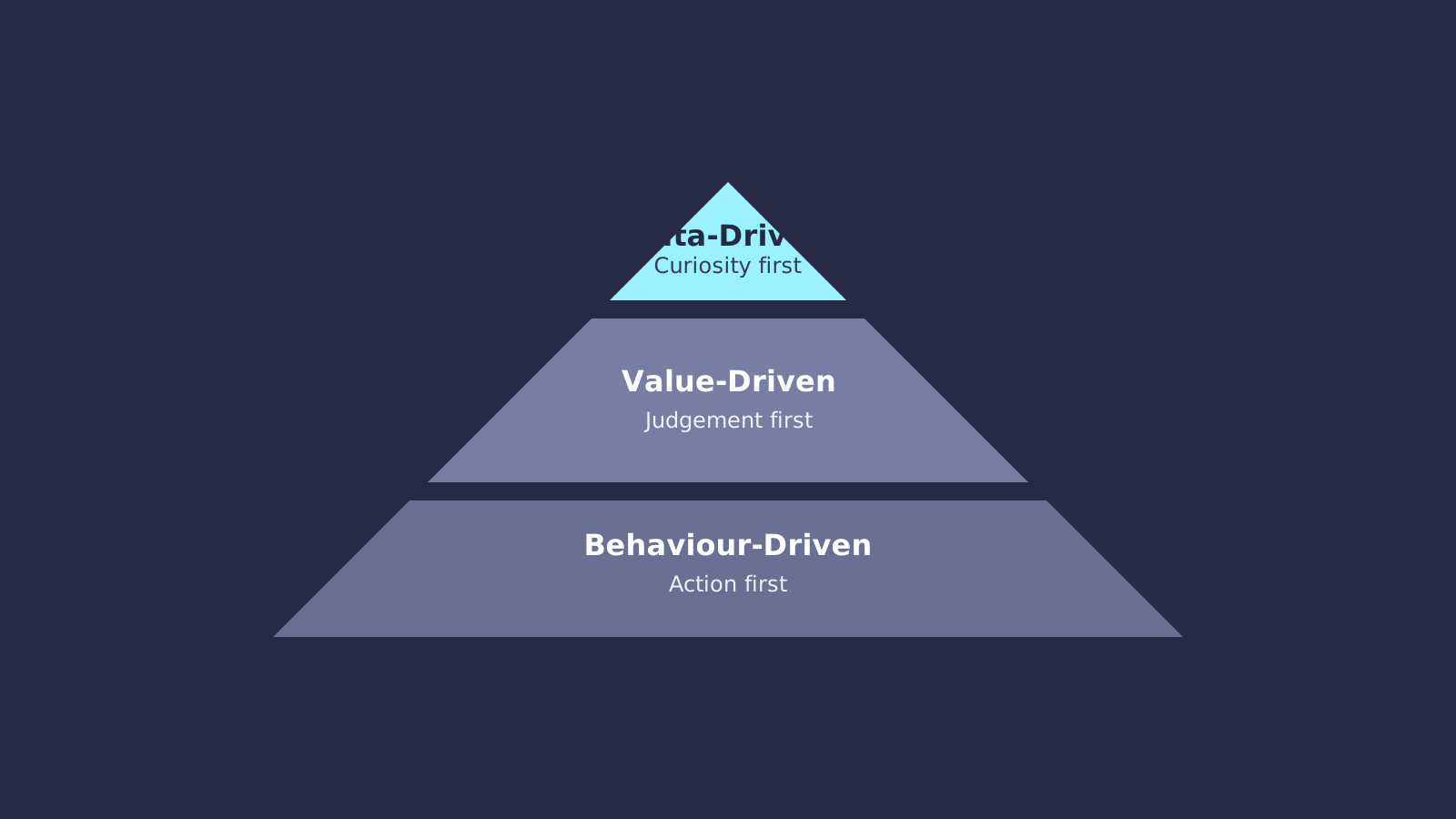
The layers differ less in how hard they are thinking than in what it takes to change their minds.
1. Action: The Behaviour-Driven Base
At the base of the hierarchy is the behaviour-driven approach. Here: action comes first.
It is uncomfortable to admit, but we often form our values based on what we do, rather than the other way around. We watch ourselves act, then build a value system that justifies it, much as we’d read a stranger’s character off their behaviour. That is roughly Bem’s account of how we come to know our own attitudes [3]. Festinger arrives at the same place by a different road [4]: when actions and beliefs conflict we feel the strain, and since we can’t easily undo what we’ve already done, the belief is what moves. Bem’s argument was that you don’t need the strain at all. Watching yourself is enough. The field never quite settled which of them is doing the work, and for this hierarchy it doesn’t much matter. Either way the value ends up downstream of the act.
We act to survive. It is a necessary foundation, heavily reliant on fast, automatic processing (System 1, to borrow from Kahneman [5]). But it is fundamentally reactive, and if you are reacting then you have less control than you think. Our values become the shadow cast by our habits.
2. Judgement: The Value-Driven Middle
The middle layer is the attitude- or value-driven approach. Here: judgement comes first.
As we develop a more stable sense of self, we begin to act on the world based on our pre-established values. We know what we stand for, and we behave accordingly.
I have a strong affinity for having “good defaults.” These are primarily attitudes that inform behaviours in new scenarios, formulated by reflection and introspection. A good default is a base, not a rule. It should leave wiggle room for the exception. For example, when organising a summer school like the Imbizo or a conference like the IndabaX, there will inevitably be crises. We let our vision and attitudes as organisers inform our response to these crises, aiming to gather information to be best informed of the situation.
However, there is a catch: we also filter new information based on those same values. This is confirmation bias at work [6]. We see what we expect to see, and we interpret data in a way that aligns with our existing beliefs. We judge the situation, apply our heuristic, and then we act. It is more deliberate than the purely behaviour-driven base, and it is also the layer that digs its own hole. New information that contradicts our values gets discarded or heavily discounted, and every piece you discount is one more sign, to you, that the value held up. So the value comes out of the encounter feeling better founded than it went in. The loop tightens with use. It is an echo chamber of one: the same selective exposure that polarises a whole network, running inside a single head. We are thinking, yes, but we are often thinking defensively.
3. Curiosity: The Data-Driven Peak
The final level, and the one I believe we should strive towards, is the data-driven approach.
Here: curiosity comes first, judgement and action follow later.
We aim to collect data—evidence in a Bayesian sense [7]—and use this information to inform both our values and our behaviours. We treat our beliefs not as sacred identity markers, but as priors to be updated when new evidence arrives.
The most useful statistical question I know is a simple one: what can this evidence be compared against? Your own experience means rather little on its own. Hold it up against something wider and it starts to mean something. A surprising number of other statistical principles fall out of that one question.
Which brings me back to the echo chamber of one, and to my work on computational sociology—specifically, my paper on opinion dynamics [8]. If the middle layer runs the same loop a polarised network runs, it is worth asking what breaks the loop at network scale. The “nudge” discussed in that piece can be crudely likened to an unbiased data filter. Echo chambers form because we are selectively exposed to people who already agree with us. That’s a filter too, just a badly biased one. The nudge doesn’t remove that skew. It runs alongside it, giving each agent its own random sample of what others in the network think, and that steady unbiased input is enough to counteract the biased one. Opinions start moving on what is observed rather than on entrenched position.
A Complement to Thinking, Fast and Slow
Kahneman’s two systems [5] are the obvious neighbour here. They’re doing a different job.
System 1 and System 2 describe the machinery of thinking: whether a judgement arrives fast and automatic, or slow and effortful. It’s a good account of how we reach an answer. It says much less about where the values doing the judging came from, or whether anything can revise them. Thinking well and forming values well are related problems. They aren’t the same problem.
And the second turns out to be largely independent of speed. You can reach a value-driven conclusion in half a second, or labour over it for a fortnight, and it’s value-driven either way. Effort tells you nothing about whether new evidence got in. Confirmation bias isn’t a failure of thinking hard [6]. Quite often it’s an achievement of it.
So the two stack. Kahneman tells you what the thinking cost, and how far to trust it under load. This tells you what was feeding it.
The Three Approaches in Practice
To make this concrete, let’s contrast how these approaches look in day-to-day scenarios.
Ordering at a restaurant
- Behaviour-driven: You order what you had last time, because that’s what you order here. On a tired Tuesday that’s a perfectly good move. The default spares you the deliberation. The “cost” only arrives later when you start telling yourself it must be the best thing on the menu.
- Value-driven: You are vegetarian, so you read the menu for what you do want and choose among the dishes that fit. The value does the filtering for you, which is mostly what you want a value to do.
- Data-driven: You ask the waiter what is good today, notice what is arriving at other tables, and try something you would not have picked on paper.
None of these approaches are inherently bad; they are all valid ways of navigating the world and indeed each can be optimal in different contexts. Yet, they differ in how they treat information and how they allow us to update our beliefs and behaviours.
Friends gossiping
- Behaviour-driven: You join in because everyone else is, and later convince yourself the person being discussed had it coming.
- Value-driven: You hold that people who can’t answer for themselves shouldn’t be discussed, so you change the subject. It’s a good rule, honestly applied. It also means you miss whatever the conversation was about to tell you.
- Data-driven: You listen, suspend judgement, and notice that someone being rude about a person to you tells you rather more about the speaker than about the person they are describing. You gather data about the social web before deciding how to act.
A business deal
- Behaviour-driven: You sign because you always say yes to opportunities, and work out afterwards how to fulfil it.
- Value-driven: You worked out long ago what kind of work you will and will not take on, and this falls outside it. Deciding once, calmly, is usually better than deciding every time under pressure.
- Data-driven: You use your values as guides, not filters. You examine the financials, the partner’s history, and the potential impact. You let the data inform your decision, while keeping your values in mind.
What the lower two layers can’t do is update themselves. A default is only ever as good as the last time you looked at it. A value that filters your evidence will go on telling you it was right all along. Neither can tell you when it stopped being right. If you want to change what you believe, rather than just act on it, you have to climb.
Science Is This, Institutionalised
Science is the data-driven layer written down and, bit by bit, made harder to dodge. Why did it need writing down?
Because left to ourselves, we do the other two. We run the experiment and write the paper to fit the result. We get attached to a hypothesis and quietly discount the outliers. Blinding, pre-registration, replication, peer review: none of that describes how naturally curious people behave. Nor did any of it arrive at once. Blinding goes back to the eighteenth century, formal peer review only to the twentieth, pre-registration to this one, and each was bolted on after some particular failure rather than designed in from the start. That is the crux: we keep having to build machinery that forces the observing to come first, because on our own we are value-based by default.
Science is a process, not a product. It is a way of thinking rather than a set of facts, a way of knowing rather than a set of knowns.
Curiosity Over Judgement
The posture I keep coming back to is a low threshold for curiosity and a high threshold for judgement. Wondering should cost you almost nothing. Concluding should cost you something.
Ted Lasso puts it more memorably than I can: “Be curious, not judgmental.” He hands the line to Walt Whitman (though it may be misattributed [9]).
When we lead with curiosity, we gather observations before we assign meaning. We allow the evidence to shape our understanding, rather than forcing the evidence to fit our existing mental models. Chris Argyris explored a similar concept with his “Ladder of Inference” [10], illustrating how quickly we leap from observable data to assumptions and conclusions. The data-driven approach asks us to stay on the bottom rungs of that ladder just a little longer.
The Tension Between Attitude and Behaviour
From my background in psychology, I know there is often a tension between attitude and behaviour. Attitudes and behaviours are not the same thing, and it is a long debate in psychology which of them comes first (hint: it depends). Wicker’s review is a useful humbling [11]. What people say about their attitudes predicts what they actually do far more weakly than you’d hope. Sometimes our attitudes drive our behaviours; other times, our behaviours shape our attitudes.
What I am aiming to contribute here is an additional layer: the idea that observation should be done first, if possible.
That “if possible” is doing real work. Sometimes the data simply isn’t there, and the honest move is to work out whether your known unknowns are knowable at all. If they are, go and know them. If they aren’t, accept, adapt, and act. Waiting for evidence that will never arrive is its own kind of avoidance.
Striving for that data-driven, curiosity-first peak is a lofty goal. It takes time, cognitive effort, and a certain level of psychological safety to suspend judgement and simply observe. But the clarity that comes from letting the evidence speak first is well worth the climb.
Resources
[1] Maslow, A. H. (1943). A theory of human motivation. Psychological Review, 50(4), 370-396. [2] Bridgman, T., Cummings, S., & Ballard, J. (2019). Who built Maslow’s pyramid? A history of the creation of management studies’ most famous symbol and its implications for management education. Academy of Management Learning & Education, 18(1), 81-98. doi:10.5465/amle.2017.0351 [3] Bem, D. J. (1972). Self-perception theory. In L. Berkowitz (Ed.), Advances in Experimental Social Psychology (Vol. 6, pp. 1-62). Academic Press. [4] Festinger, L. (1957). A Theory of Cognitive Dissonance. Stanford University Press. [5] Kahneman, D. (2011). Thinking, Fast and Slow. Farrar, Straus and Giroux. [6] Nickerson, R. S. (1998). Confirmation bias: A ubiquitous phenomenon in many guises. Review of General Psychology, 2(2), 175-220. [7] Griffiths, T. L., Kemp, C., & Tenenbaum, J. B. (2008). Bayesian models of cognition. In R. Sun (Ed.), The Cambridge Handbook of Computational Psychology (pp. 59-100). Cambridge University Press. [8] Currin, C. B., Vallejo Vera, S., & Khaledi-Nasab, A. (2022). Depolarization of echo chambers by random dynamical nudge. Scientific Reports, 12, 9234. doi:10.1038/s41598-022-12494-w [9] “Be curious, not judgmental” is routinely credited to Walt Whitman, but it does not appear in his published writing and the attribution remains unverified. [10] Argyris, C. (1982). Reasoning, Learning, and Action: Individual and Organizational. Jossey-Bass. [11] Wicker, A. W. (1969). Attitudes versus actions: The relationship of verbal and overt behavioral responses to attitude objects. Journal of Social Issues, 25(4), 41-78.